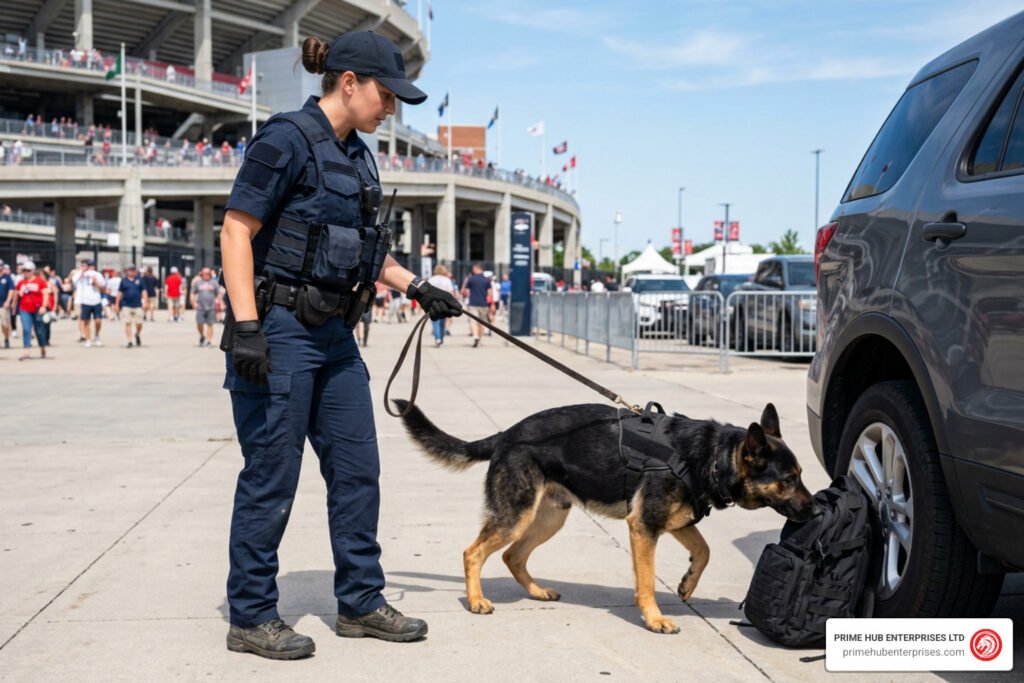
Why K9 Explosive Detection Matters for Venue Security
K9 explosive detection uses trained dogs and skilled handlers to search for the odours linked to explosive materials before they can put people, property, or events at risk.
For a venue manager or property owner, the quick answer is simple:
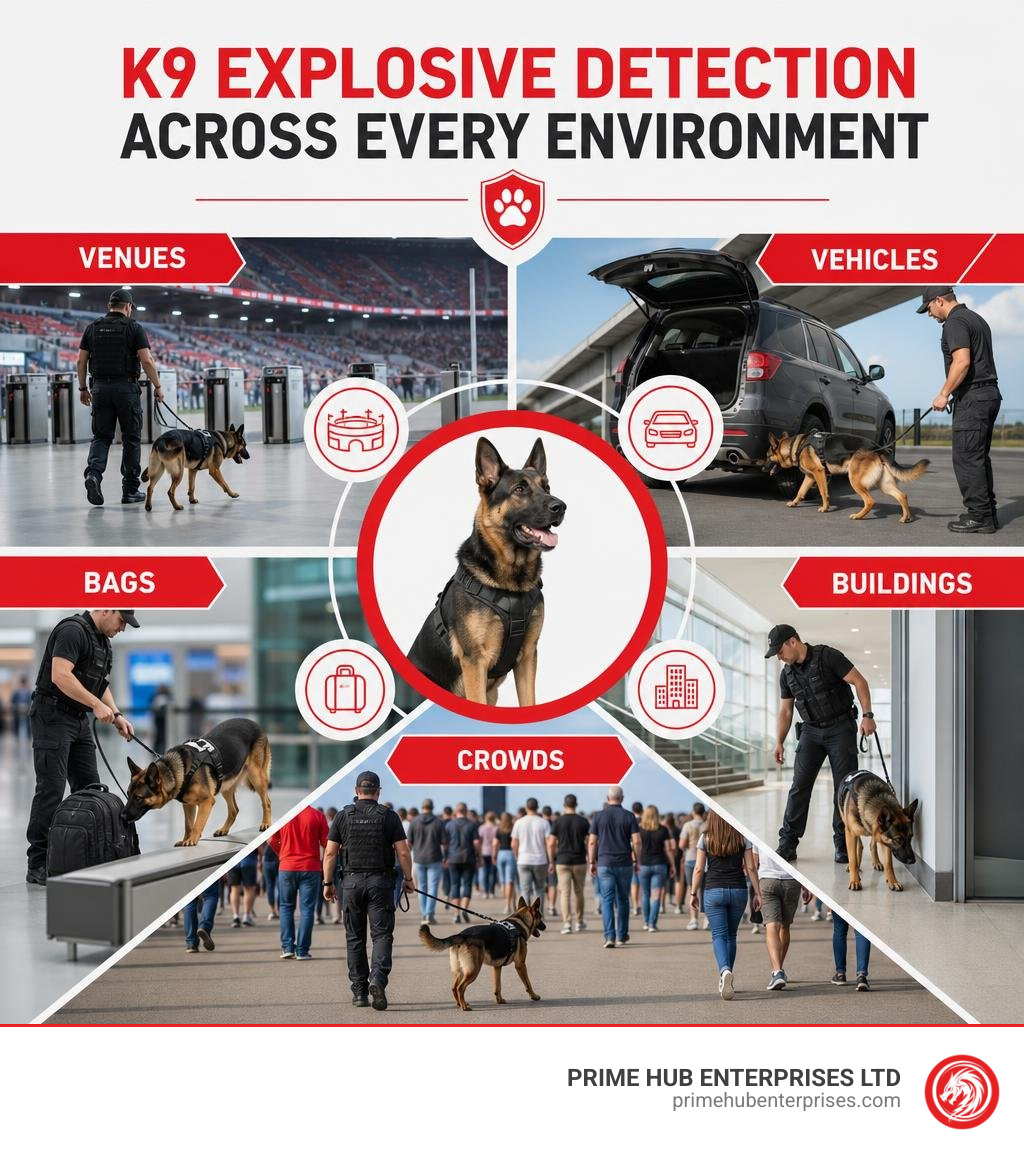
- Detection dogs can screen bags, vehicles, buildings, outdoor areas, and crowds.
- They are commonly used before major events, during transport security operations, and when responding to a suspicious item or bomb threat.
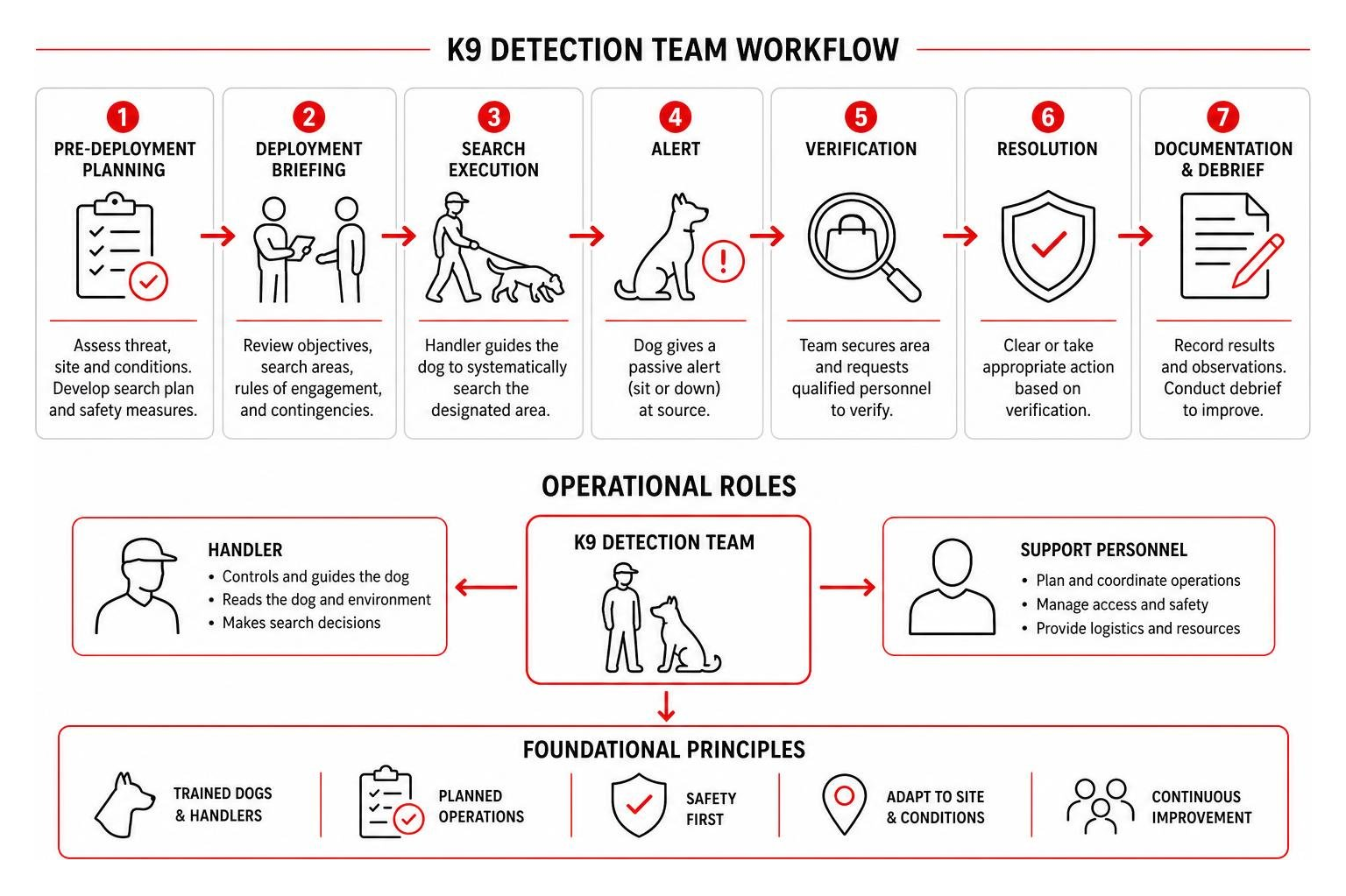
- Most explosive detection dogs give a passive alert, such as sitting or lying down, rather than scratching at a possible device.
- A dog is not a stand-alone tool. Reliable results depend on the full team: the dog’s training, the handler’s decisions, the search plan, and the conditions on site.
Dogs are powerful biological sensors, but their work must be planned and managed carefully. Noise, heat, crowd pressure, unfamiliar odours, handler cues, and poorly controlled training can all affect results. For security-sensitive sites, K9 teams add a visible deterrent and a fast way to search areas that would take people far longer to clear.
Operational Roles and Agency Frameworks for Detection Canines
When we look at modern security networks, explosive detection canine (EDC) teams serve as a front-line defense across a wide spectrum of environments. Different public and private bodies deploy these teams based on their specific operational footprints.
For instance, the Transportation Security Administration (TSA) maintains one of the largest forces in the world, deploying 1,076 active canine teams nationwide as of recent reports. In 2025 alone, TSA teams conducted over 430,000 explosive sweeps and dedicated roughly 160,000 hours to operational training exercises. These teams safeguard transit hubs, airport terminals, air cargo facilities, and rail lines. About 60% of graduating TSA teams pair local or state law enforcement officers with working dogs, while 40% consist of transportation security specialists.
Local law enforcement agencies frequently integrate these specialised animals into daily operational duties. Take K9 Amp of the El Paso County Sheriff’s Office, who completed approximately 1,700 hours of specialized training since 2022 and has been deployed on more than 50 active missions. Working canines trained for K9 explosive detection are taught to display passive alert behaviors—meaning they sit or lie down motionless near an odour source rather than biting, barking, or scratching. This passive response prevents the accidental detonation of sensitive secondary fuses or improvised explosive devices (IEDs).
To understand how federal law enforcement pushes search boundaries, we can look at the Search Enhanced Evidence K-9 (S.E.E.K.) Program | ATF, which trains specialized canine teams to locate both commercial and homemade explosives alongside firearm-related evidence like discarded weapons and spent shell casings.
Public Transit and Mass Venue Screening
Screening high-density pedestrian traffic requires specialized tactics compared to checking static luggage or stationary vehicles. The Department of Homeland Security (DHS) Science and Technology Directorate (S&T) established the Person-Borne Improvised Explosive Device (PBIED) Canine Initiative in 2012 to establish scientific performance limits for canines working in mass transit hubs and crowded public arenas.
Through extensive parametric testing, researchers developed guidelines to “up-train” traditional static detection dogs into mobile Person-Borne Explosive Detection (PBED) assets. These dogs navigate moving crowds to capture lingering scent plumes shedding off moving targets.
Under specialized protocols like the ATF’s S.E.E.K. program, dogs learn to work off-leash at distances up to 150 yards away from their handler. Operational profiles of dogs like Barny | ATF demonstrate how a single S.E.E.K. canine can sweep a 60,000-square-foot field covered in thick vegetation in roughly 45 minutes—a task that would take a human search team hours of painstaking effort.
VIP Protection and Post-Blast Investigations
In high-stakes protective details, EDC teams carry out crucial pre-event sweeps for visiting dignitaries, heads of state, and VIPs. Proactive sweeps cover podiums, backstage green rooms, parade routes, and motorcade paths.
When bomb threats occur or post-blast investigations unfold, explosive detection dogs are deployed to locate secondary hazards, unexploded components, or tiny fragments of ballistic evidence. High-level working dogs are trained to identify six fundamental explosive chemical families, allowing them to recognize over 19,000 distinct explosive odour combinations. Local law enforcement partnerships, like the deployment of El Paso County Sheriff’s Office Welcomes First Explosives Detection K9 – El Paso County Sheriff’s Office, demonstrate how regional homeland security grants allow agencies to share these high-value assets during VIP visits and major community gatherings.
Standards vs. Reality: The Science and Mechanics of K9 Explosive Detection
While dogs are often viewed as absolute detection tools, scientific research reveals nuanced performance realities in field conditions. In December 2022, the American Academy of Forensic Sciences Standards Board published ANSI/ASB Standard 092, establishing standardized testing requirements under the guidance of the Organization of Scientific Area Committees (OSAC) Dogs and Sensors subcommittee. To pass standard certification, a team must achieve a minimum 90% correct alert rate with less than a 10% false alert rate.
A landmark 2025 multi-site black box validation study published in Frontiers in Veterinary Science evaluated 56 active operational canine/handler teams across three geographical regions. The study subjected teams to single-blind standard searches alongside real-world operational scenarios (such as parcel screening, vehicle checks, and large-area searches).
The empirical results were eye-opening: zero out of the 56 participating teams met the full passing criteria required for ANSI/ASB Standard 092 certification across all trials. However, the study confirmed that performance on standard assessments strongly correlated with performance in realistic operational scenarios, proving that standardized testing is an accurate predictor of real-world operational effectiveness.
Further details regarding real-world requirements and operational constraints can be explored in Expert Perspectives on the Performance of Explosive Detection Canines: Operational Requirements.
Key Factors Affecting K9 Explosive Detection Performance
A working canine’s ability to locate targets is driven by several dynamic variables:
- Intrinsic Hunt Drive: A dog’s persistent motivation to search for target odours without immediate rewards is its primary cognitive asset. High hunt drive keeps the dog vigilant during long, repetitive searches.
- Handler Influence and Unconscious Cueing: Handlers frequently influence outcomes through subtle body language, altered search pacing, or subconscious tension on the leash, which can trigger accidental alerts.
- Environmental and Thermal Stress: Ambient heat, humidity, dust, and lack of airflow degrade olfactory acuity. Proper climate acclimation is essential before deploying teams into harsh operational environments.
- Target Odour Soak Times: Target materials require time to vaporize and establish a stable scent plume. Testing shows search areas require a minimum 30-minute target soak time to form realistic scent pictures.
Distractor Vulnerabilities and False Alert Dynamics
False alerts pose severe operational challenges, leading to unnecessary venue evacuations, costly delays, and compromised courtroom defensibility. In the 2025 black box study, teams evaluated during Trial 2 recorded false alert rates of 15% in operational scenarios and 13% in standardized tests, despite achieving high correct response rates.
Interestingly, canines generated significantly more false alerts when encountering everyday commercial distractors than empty blank containers (14% scenario distractor false alert rate vs 8% on blank targets). The non-target items causing the highest false alert rates included:
- Sharpie permanent markers
- Anti-static packaging bags
- Dryer sheets
- Isopropanol disinfectant wipes
To maintain legal defensibility and eliminate handler bias, training protocols must utilize single-blind and double-blind search setups, ensuring handlers cannot inadvertently guide dogs toward suspected hidden targets.
Program Standardization and Advanced Training Initiatives
Standardizing detection performance across federal, state, local, and private sectors remains an ongoing challenge. Programs sponsored by the DHS S&T Detection Canine Program, such as the Regional Explosives Detection Dog Initiative (REDDI), bridge these gaps by providing expert outreach events, field assessments, and technical knowledge sharing for handler teams nationwide.
Training investments vary considerably depending on the team’s intended operational deployment profile:
| Feature / Metric | Traditional Explosive Detection K9 | Passenger Screening / PBED Canine | ATF S.E.E.K. Canine Program |
|---|---|---|---|
| Primary Operational Focus | Static baggage, vehicles, buildings, area sweeps | Dynamic pedestrian crowds, transit hubs | Off-leash sweeps, evidence recovery, firearms |
| Course Duration | 11 Weeks | 16 Weeks | 24 Weeks (12 K9 / 12 Team) |
| Average Cost per Team | $26,000 | $65,000 | High specialized federal investment |
| Search Range / Style | On-leash, systematic pattern search | On-leash mobile crowd tracking | Off-leash up to 150 yards away |
| Handler Requirement | Standard security / law enforcement officer | TSA Specialist or Law Enforcement | 5+ years criminal investigator experience |
TSA Canine Training Center Standards
Located at Joint Base San Antonio-Lackland, the TSA Canine Training Center spans 25,000 square feet and features 17 indoor mock venues—including simulated airport gates, aircraft cabins, luggage plazas, rail cars, and air cargo facilities.
- Annual Graduation Output: The facility trains an average of 300 canines annually, maintaining approximately 125 canines in training at any given time.
- Graduation Rate: Approximately 80% of dogs assigned to the center successfully graduate.
- Primary Breeds: The program utilizes five primary breeds: German Shepherds, Labrador Retrievers, German Shorthaired Pointers, German Wirehaired Pointers, and Belgian Malinois.
- Evaluation Criteria: Teams are continuously assessed across four core operational elements:
- Explosive odour recognition.
- Handler interpretation of canine behavior changes.
- Logical and systematic search execution.
- Pinpointing the precise source of the odour plume.
ATF S.E.E.K. Program Protocols
The ATF Search Enhanced Evidence K-9 (S.E.E.K.) program operates out of Front Royal, Virginia, delivering a 24-week curriculum split into 12 weeks of foundational canine imprinting followed by 12 weeks of joint team instruction.
Candidates must possess at least five years of criminal investigation experience before entering the program. Dogs like Kali | ATF are cross-trained across six primary explosive compound groups (commercial, military, and homemade formulations) and learn off-leash directionals to clear open stadiums, complex terrain, or suspect vehicles efficiently.
Challenges in Explosive Odor Discrimination and Target Scarcity
One of the greatest operational obstacles in K9 explosive detection is safe access to authentic explosive compounds. Standardizing dog training requires exposing animals to diverse chemical formulations, including military energetics (RDX, PETN), commercial powders, and volatile homemade explosive (HME) mixtures containing nitrate, chlorate, or peroxide bases.
Because acquiring and storing live explosive materials presents major legal and safety hurdles, modern programs utilize advanced presentation devices such as Training Aid Delivery Devices (TADDs) and Magnetically Operated Delivery Devices (MODDs). These tools encapsulate volatile chemical headspace while preventing direct physical contact or cross-contamination.
Chemical headspace sampling allows scientists to analyze the exact volatile organic compounds (VOCs) evaporating off an explosive. This chemical profiling enables the creation of non-detonable training aids that present identical olfactory signatures to the dog without explosive hazard risks.
Emerging Technologies and Research in K9 Explosive Detection
Modern canine research continues to push performance limits through multidisciplinary scientific fields:
- Olfactory Sensitivity Thresholds: Canines possess nearly 300 million nasal olfactory receptors, enabling them to detect target chemical vapor concentrations as low as parts-per-trillion (ppt).
- Genetics and Genomic Selection: Breeding programs analyze specific genetic markers linked to high hunt drive, environmental resilience, and low anxiety to boost graduation rates.
- Machine Learning Scent Profiling: Advanced instruments like gas chromatography-mass spectrometry (GC-MS) combined with machine learning models map exact scent plumes to standardize odor intensity during trials.
- Vigilance Retention Training: Research focuses on maintaining search motivation when dogs perform hours of repetitive sweeps without finding targets, ensuring they remain ready to alert on rare real-world threats.
Frequently Asked Questions
What certification standards govern explosive detection dogs?
Explosive detection canine teams are evaluated against uniform criteria like ANSI/ASB Standard 092 (developed under OSAC oversight). Federal agencies utilize specialized testing frameworks, such as the ATF National Odor Recognition Test (NORT) and the TSA Canine Assessment Program. In state and local sectors, certifications from bodies like the National Police Canine Association (NPCA) validate team proficiency through annual evaluations.
How much does it cost to train an explosive detection K9 team?
According to official TSA metrics, training a traditional static explosive detection canine and handler costs an average of $26,000. In contrast, training a specialized passenger screening or person-borne detection team costs approximately $65,000 due to extended 16-week training timelines, complex crowd venue requirements, and specialized instructional resources.
Why do detection dogs give false alerts during searches?
False alerts stem from several environmental and operational factors. Household or industrial chemical distractors—such as Sharpie markers, anti-static bags, or isopropyl alcohol—can off-gas volatile compounds that mimic components of synthetic explosives. Unconscious handler cues, leash tension, handler fatigue, cross-contaminated training aids, or inadequate target soak times can also cause a dog to give a false alert.
Conclusion
Effective K9 explosive detection requires a delicate balance of biological capability, scientific training methodology, rigorous certification standards, and skilled handler leadership. As threat profiles evolve, integrated security measures must adapt to protect high-density public venues, commercial facilities, and transport networks.
At PRIME HUB ENTERPRISES LTD, we deliver comprehensive, technology-enabled private security solutions across the United Kingdom. By combining professional guarding, close protection, gatehouse management, and specialized K9 patrol capabilities with advanced risk-management strategies, we ensure your premises remain fully protected against security risks.
To learn more about how our tailored security strategies can safeguard your venue, discover our complete guide on Understanding UK Security Guard Services, Close Protection, and Bodyguard Services and contact our specialist team today.