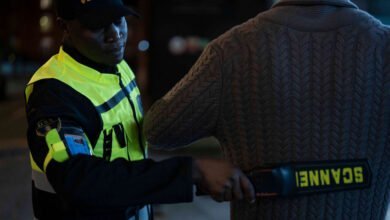
What SIA Door Supervisors Do and Why Licensing Matters
SIA door supervisors are trained, licensed security professionals who manage entry, protect people, and help keep licensed venues safe. For venue managers and property owners, they provide a visible first line of safety at doors, gates, and busy public spaces.
In the UK, door supervisors commonly work at pubs, clubs, music venues, events, and other places where alcohol is served or crowds need managing. Their work can include checking IDs, enforcing entry rules, spotting risks, handling conflict calmly, recording incidents, and responding to emergencies.
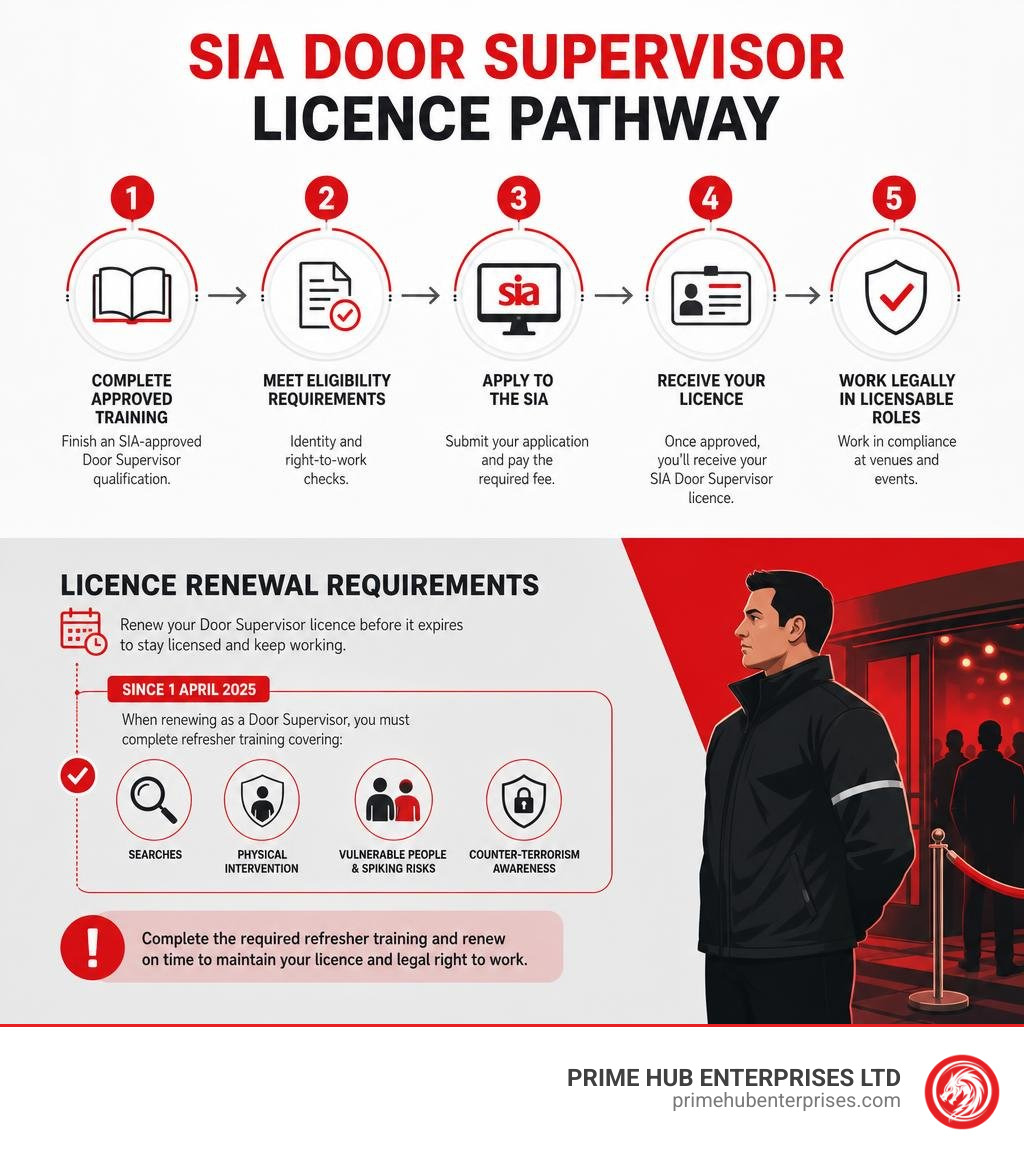
To work legally in a licensable role, a person generally needs an SIA Door Supervisor licence. This involves completing an approved qualification, meeting identity and right-to-work checks, and applying to the Security Industry Authority (SIA). Since 1 April 2025, licence holders renewing as door supervisors must also complete refresher training covering searches, physical intervention, vulnerable people and spiking risks, and counter-terrorism awareness.
For businesses, choosing properly licensed door supervision is not simply a compliance task. It helps protect customers, staff, premises, and reputation when pressure is high.
Roles and Responsibilities of SIA Door Supervisors
The role of a door supervisor goes far beyond standing at an entrance and checking physical access. At Prime Hub Enterprises Ltd, we recognize that SIA door supervisors serve as the public face of security for host venues, blending customer support with rigorous threat management and entry control.
Their legal and operational focus centers on protecting patrons, maintaining order, managing conflict, and applying non-violent de-escalation tactics—stepping in with safe physical intervention only when absolutely necessary to prevent harm.
Core Duties of SIA Door Supervisors
The everyday tasks of a door supervisor require constant situational awareness and effective communication skills. Key obligations include:
- Entry Enforcement and Access Control: Verification of legal age, monitoring capacities, assessing sobriety, and checking identification documents.
- Crowd Management: Directing queues smoothly, ensuring fire exits remain clear, and preventing overcrowding in sensitive internal zones.
- Conducting Searches: Carrying out lawful searches for prohibited items such as drugs, weapons, or unapproved containers in line with venue conditions.
- Conflict Management: Identifying early signs of friction, defusing heated verbal arguments, and managing polite turned-away patrons.
- Emergency Response and Incident Reporting: Orchestrating venue evacuations, administering immediate emergency first aid, coordinating with emergency services, and maintaining clear written incident logbooks.
Work Environments and Licensed Venues
While commonly associated with late-night hospitality, modern licensed security door personnel operate across a diverse set of private and public environments:
- Nightclubs, Pubs, and Bars: Managing late-night crowds, managing alcohol-related risks, and keeping premises safe.
- Live Music Venues and Theatres: Regulating ticket entry, managing stage barriers, and assisting crowds.
- Outdoor Festivals and Sporting Events: Coordinating entry perimeter control across temporary sites and large outdoor open spaces.
- Corporate and Public Sector Venues: Assisting with high-profile brand activations, private corporate functions, and high-footfall civic events.
SIA Door Supervisor Training, Entry Requirements, and Costs
Becoming a fully certified operative requires going through a standardized learning structure established by the Security Industry Authority (SIA). Following major national updates introduced in April 2021 and October 2024, training standards ensure operatives are equipped with modern safety skills.
To enrol on an SIA Door Supervisor course, candidates must meet specific entry prerequisites:
- Age Eligibility: Must be aged 18 or older to hold a licence (funded adult training options often apply to learners aged 19+).
- Right to Work: Proof of legal right to work within the United Kingdom.
- English Competency: Passing an initial English language assessment at a minimum Level 1 standard (covering reading, writing, and speaking).
- Identity Verification: Valid original identification including a Passport or UK Photocard Driving Licence alongside two proof-of-address documents (such as utility bills or bank statements dated within the last 3 months).
- Background and DBS Check: A criminal record background check during the formal SIA application phase.
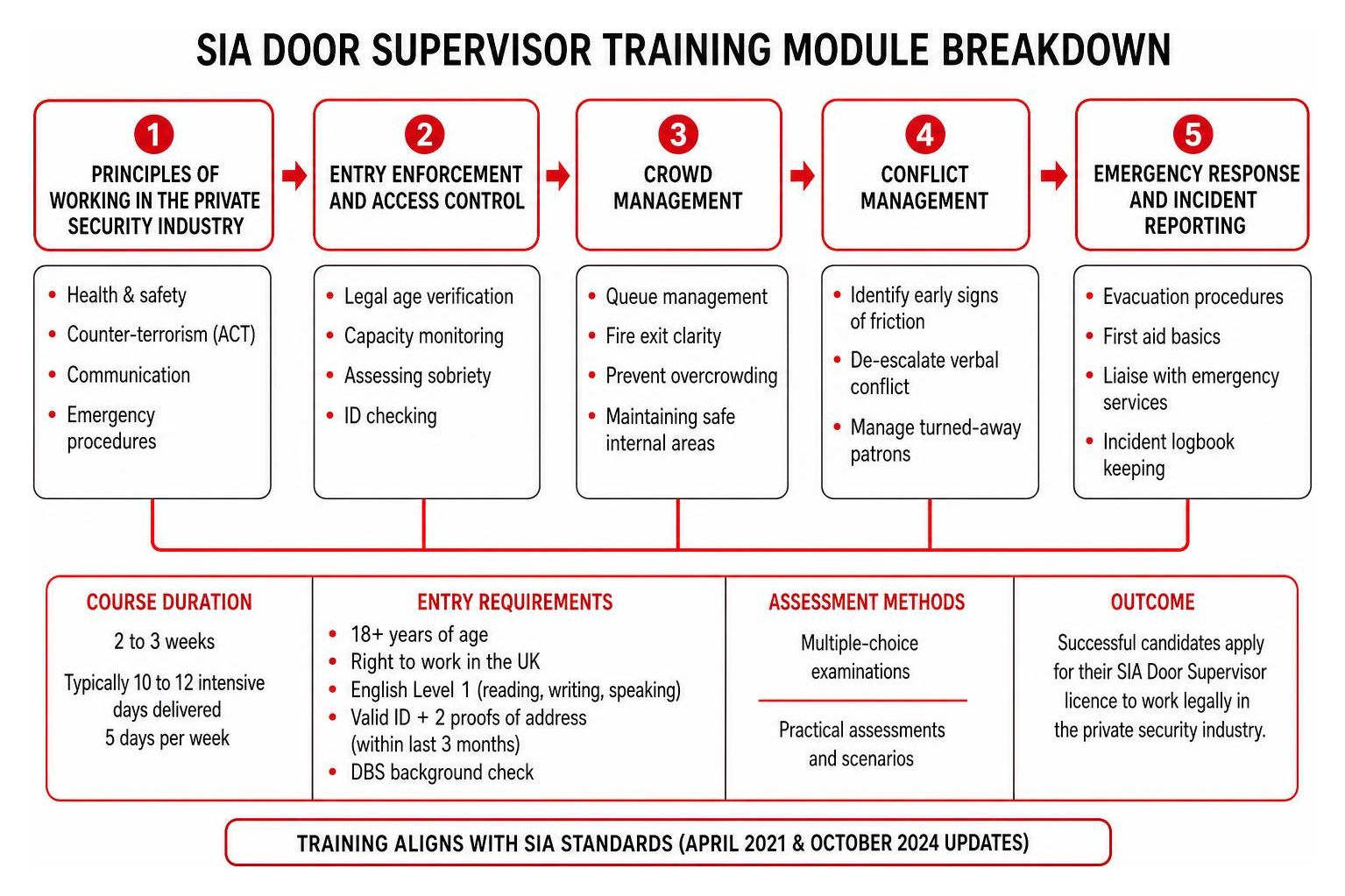
Course durations generally range from 2 to 3 weeks depending on the specific delivery format (typically 10 to 12 intensive days delivered 5 days per week). Training costs vary across commercial providers, but adult candidates aged 19+ may qualify for fee waivers or government-funded training options through localized adult education programs.
| Course Module | Key Topics Covered | Assessment Method |
|---|---|---|
| Principles of Working in the Private Security Industry | Health & safety, counter-terrorism (ACT), communication, emergency procedures | Multiple-choice examination |
| Principles of Working as a Door Supervisor | Entry control, crowd management, searching procedures, licensing law, spiking awareness | Multiple-choice examination & practical evaluation |
| Conflict Management for the Private Security Industry | De-escalation, communication tactics, risk mitigation, space management | Practical demonstration & scenario exam |
| Physical Intervention Skills | Escort techniques, holding methods, non-restrictive physical intervention, risk reduction | Practical assessment & physical evaluation |
Qualification Curriculum and Extra Certifications
The formal Door Supervisor qualification integrates several specialized certifications vital for modern venue security:
- Emergency First Aid in the Workplace (EFAW): Operatives must complete or hold a valid First Aid qualification before taking physical intervention modules.
- ACT Counter-Terrorism Training: Specialized Action Counters Terrorism awareness module providing actionable insights into terror threat mitigation.
- Vulnerability and Spiking Protection: Targeted instruction on identifying vulnerable individuals, recognizing drug-facilitated sexual assault or spiking attempts, and implementing safeguarding duties.
- Mental Health Awareness & Employability Skills: Extended training paths often incorporate basic mental health awareness and practical financial literacy or job-readiness skills.
Assessment Methods and Progression Pathways
Assessments are thoroughly structured across practical and theoretical disciplines. Candidates complete coursework workbooks, practical real-world scenario demonstrations (such as search procedures and conflict de-escalation), physical skills evaluations, and supervised multiple-choice examinations.
Once qualified, a door supervisor can pursue further professional development pathways across the security landscape, including:
- CCTV (Public Space Surveillance) Operator: Acquiring additional licensing to work in dedicated control rooms monitoring surveillance networks.
- Spectator Safety and Event Stewarding: Progressing into crowd management supervision at major national stadiums and festivals.
- Security Team Management: Advancing into head door supervisor roles, venue security management, or specialized close protection services.
Mandatory Refresher Training and Renewal Requirements
Maintaining high operational standards requires continuous training update cycles. Following the full standardization of top-up awards completed by October 2024, the SIA introduced mandatory renewal rules starting in early 2025.
As stated in the official announcement on SIA confirms refresher training will be required for some licence renewals – GOV.UK, starting from 1 April 2025, all existing door supervisors must complete mandatory refresher training before renewing their individual licences.
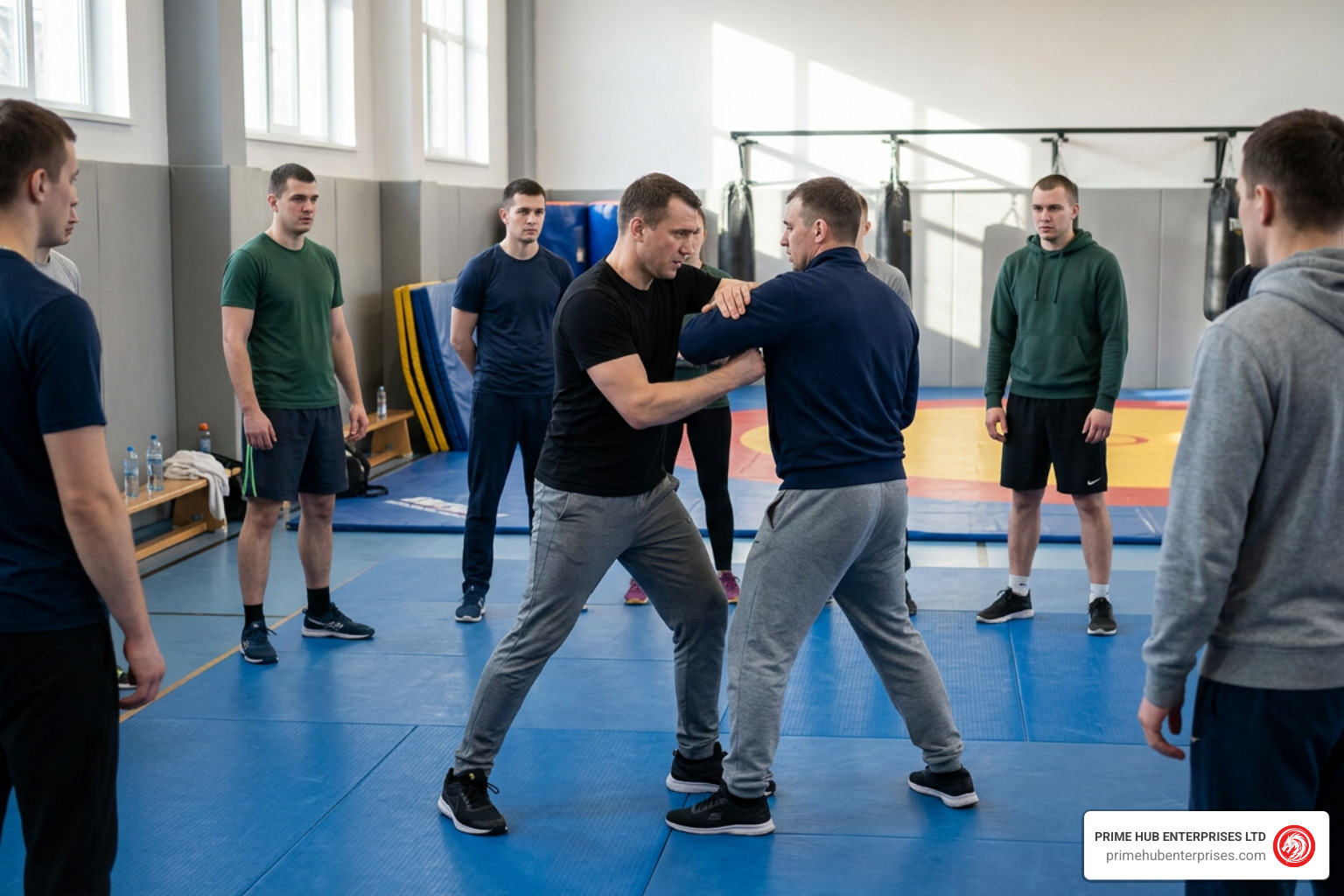
Renewal Rules for SIA Door Supervisors
Because operational environments and threat levels evolve over time, skills can fade if not periodically practiced. The compulsory refresher framework ensures active operatives stay up to date with modern best practices.
Key elements of the refresher requirements include:
- Refresher Curriculum: Dedicated practical instruction covering updated search protocols, physical intervention skills, protecting vulnerable people (including spiking mitigation strategies), and updated ACT counter-terrorism awareness.
- Prerequisite Requirements: Operatives renewing their licence must ensure their Emergency First Aid certification remains current before sitting the refresher course.
- Licence Transition Flexibility: Door supervisors who no longer require physical intervention skills or entry control duties have the option to undertake the security guard refresher course instead, allowing them to switch to a Security Guard licence upon renewal.
Frequently Asked Questions About SIA Door Supervision
How long does the SIA door supervisor course take to complete?
The standard SIA Door Supervisor qualification takes between 2 to 3 weeks to complete depending on whether it is taken as a condensed intensive course or a broader employability pathway. Course schedules usually run 5 days per week and combine physical classroom contact hours, practical movement training, and invigilated exams.
Can I get free funding for the door supervisor course?
Yes, funding is frequently available for eligible adult learners aged 19 and older via government-backed training programs or local adult education providers. Eligibility typically depends on employment status, residency, and prior qualification levels. Funded pathways often include additional support such as First Aid certificates, ACT training, and job interview placement assistance.
What documents are required for an SIA licence application?
When applying for an SIA Door Supervisor licence, applicants must provide:
- A valid, original identity document such as a Passport or UK Driving Licence.
- Two separate proof-of-address documents (e.g., utility bill, council tax letter, or bank statement) issued within the last 3 months.
- Proof of your completed Level 2 Door Supervisor qualification (and valid First Aid certificate).
- Details for a criminal record background check (DBS).
Conclusion
At Prime Hub Enterprises Ltd, we know that effective security is built on professionalism, rapid assessment, and thorough regulatory compliance. Modern SIA door supervisors do far more than manage entry—they build safer environments, reduce risk, protect vulnerable venue guests, and handle challenging situations with calm expertise.
Whether managing high-profile nightlife spots or securing major commercial sites, having well-trained security operatives keeps your operational premises safe and protected.
Learn more about UK security guard services and the role of door supervision to see how our integrated, technology-driven security options can help safeguard your people and property.